Looking for A Summer Read? Consider my Novel, “War College”
Set in the Vietnam War era, a story of conflicts, at home and abroad

Summary and Reviews on Amazon:
https://www.amazon.com/War-College-Thomas-Barnico/dp/1737562006
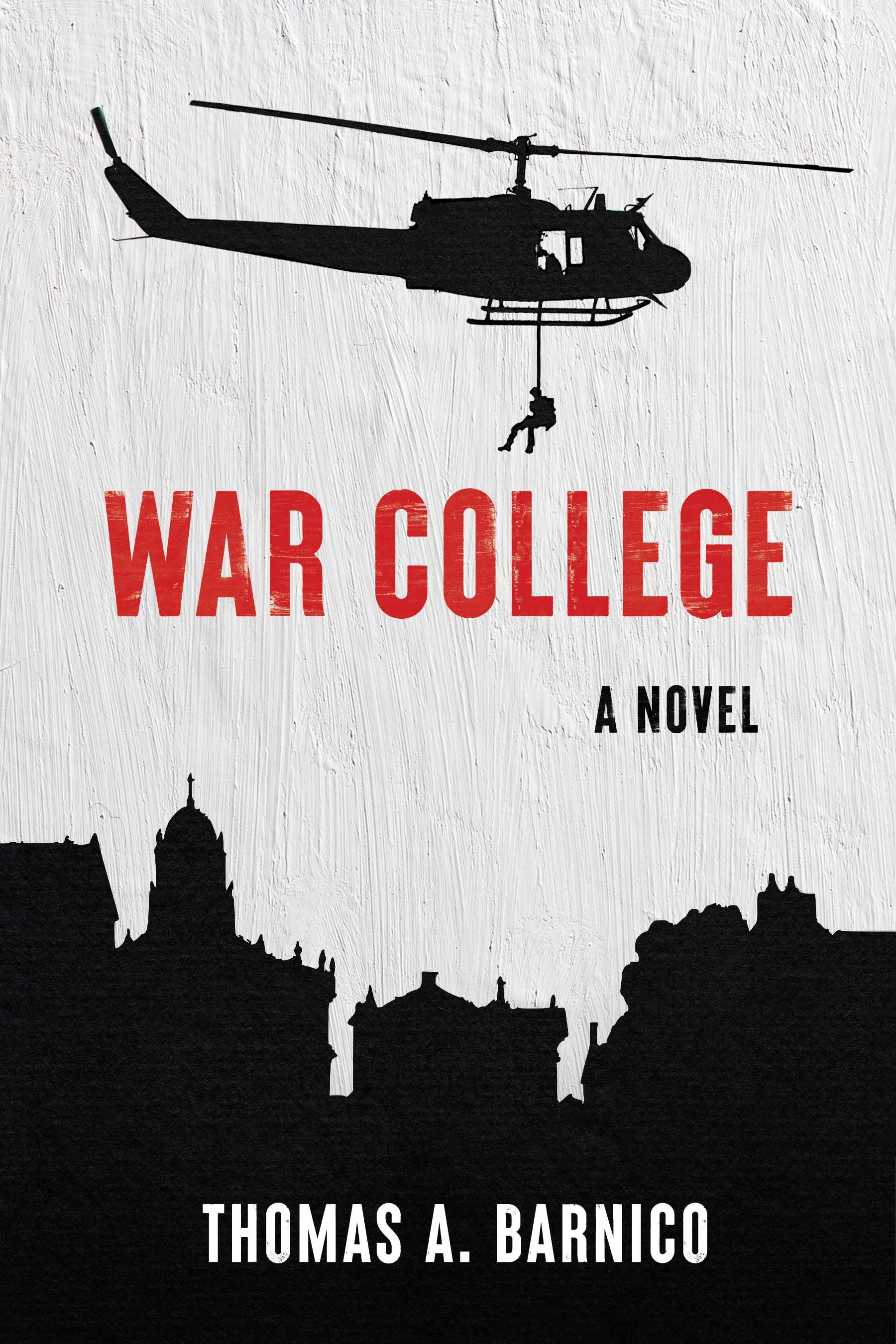
Summary:
Jack Dunne lives two lives: one in Vietnam in Army intelligence and the other as a student on an elite American campus. Bridging these worlds challenges Jack as much as the war itself. His service sparks endless conflicts: between Jack and his girlfriend, the fiery Clare McUsic, who protests the war at her women’s college, and among Jack’s teachers and fellow students—some violently anti-war—whose ivy-draped campus erupts in 1969.
Two million Americans served in Vietnam and fifty-eight thousand of them died. At three elite eastern colleges, nearly thirty thousand men graduated between 1962 and 1972, yet few of them ever stepped foot in Vietnam. Jack Dunne did. War College follows a road less traveled in Vietnam War fiction: a journey from campus to war and back, traveled by a student who served.
Excerpt:
Jack visited campus on leave from Vietnam in late summer, 1970. He had been away for ten months. His two-year enlistment was not up until the end of December, but the college president had arranged another special leave for him. President Onion’s recruits for Army intelligence said they flew “Onion Air” back home for these unusual breaks.
Early in the morning of his first day back on campus, Jack drove to the Veterans Hospital. As he made his way up the long driveway, he thought about his many visits there and what Tiemo meant to him. His visits to Tiemo seemed less a choice than the work of magnetism: he was drawn to this man, and to his physical presence and wisdom, like iron filings to a magnet. Tiemo was a link to a father Jack never knew. When Tiemo spoke to Jack, his words touched something very deep in the younger man’s soul, words new, yet familiar, traveling across space and time.
. . .
Tiemo continued:
“I wish we could get you some help over there, Jack. Recruiting is still a slog. ”
Tiemo paused. His eyes left Jack and drifted toward the window and the hills, as if he had heard a distant sound. He shook his head, as if to say, ‘No, no, no answers out there, not for me.’
“It’s not in my nature to second-guess the young guys, Jack. Even the conscientious objectors. Why shouldn’t they take the paths open to them? The paths of least resistance. The paths to a safe harbor. I knew what I signed up for in World War II. Some of us are born to do these jobs, the dirty work, and some aren’t.
…
Tiemo bowed his head onto his chest, breathed in slowly, then exhaled in one long breath as he sighed.
“I admire you guys who go. You know that. But I worry about your future. I can see the days ahead, long after I’m gone. Vietnam will be over and, God willing, all of you will be home. You’ll take your place among your generation and you’ll do all of the things that make up a life, the successes, the heartbreaks, and all the rest. But here is what I also see:
“There will always be a river, a mile wide and a mile deep, dividing the guys who went to war from the guys who did not. And nothing you can do will ever change that fact, or narrow that gap. And you shouldn’t even try.”